

The Fake Line
The Fake Line
Jean Luc Cornille
CLICK IMAGE TO ENLARGE

 twitter
 facebook
 pinterest
 linkedin
THE FAKE LINE
When Embellishment Replaces Understanding
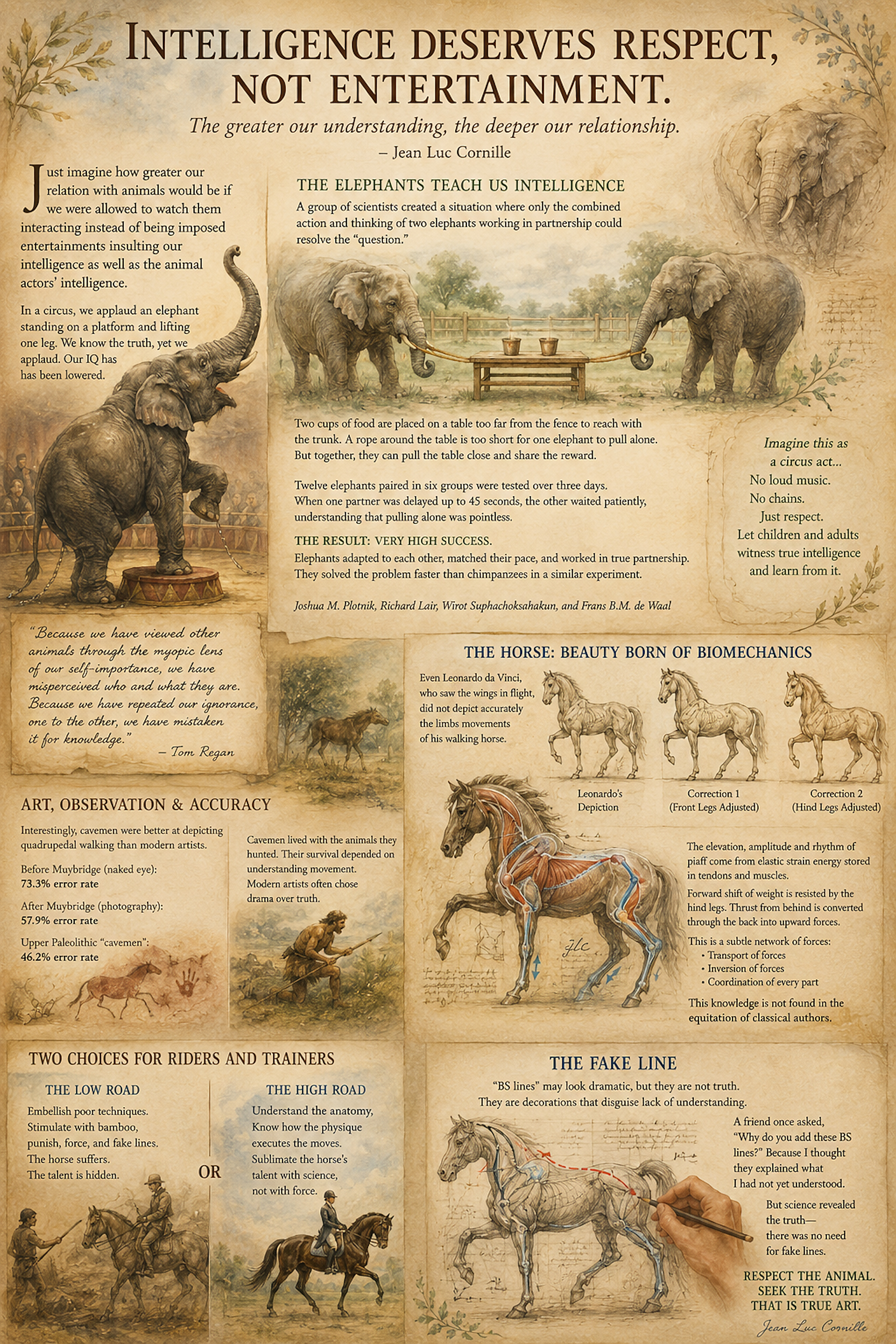
Imagine how much deeper our relationship with animals might become if we were encouraged to observe their intelligence rather than applaud performances that diminish both theirs and ours.
In a traditional circus, an elephant may be ordered to stand on a platform and raise one leg. The audience is expected to admire the act, yet there is nothing remarkable in the movement itself. Worse, such performances have historically been produced through restraint, fear, punishment, and coercion. The animal’s extraordinary intelligence is reduced to obedience, while the audience is trained to applaud submission as entertainment.
Now imagine something entirely different.
Two elephants are presented with a problem that neither can solve alone. Beyond a fence sits a table holding two bowls of food. The table is too far away for either elephant to reach with its trunk. A rope is threaded around the table, but it cannot be used successfully by only one animal. To move the table close enough, both elephants must pull opposite ends of the rope at the same time.
The question is no longer, “Will the elephant obey?”
The question becomes, “Can the elephants understand the problem, recognize the need for cooperation, and coordinate their actions?”
They could.
In research conducted by Joshua M. Plotnik, Richard Lair, Wirot Suphachoksahakun, and Frans B. M. de Waal, elephants quickly learned that success required a partner. When the arrival of the second elephant was delayed, the first often waited rather than pulling uselessly on the rope alone. The elephants adjusted to one another’s timing and style. When one pulled faster, the other resisted or compensated. Across the experiment, their success rate was remarkably high.
This is the animal intelligence we should be watching.
Imagine such an experiment presented publicly—not beneath blinding lights and deafening music, but in silence, with the problem clearly explained. Children and adults could watch two gentle giants think, wait, cooperate, and resolve a challenge peacefully.
The lesson would not be obedience.
It would be intelligence.
Tom Regan expressed the problem precisely:
“Because we have viewed other animals through the myopic lens of our self-importance, we have misperceived who and what they are. Because we have repeated our ignorance, one to the other, we have mistaken it for knowledge.”
The quality of observation matters not only in our relationship with animals, but also in the way we represent their movement.
Interestingly, studies comparing depictions of quadrupedal locomotion suggest that Upper Paleolithic artists often represented animal movement more accurately than many modern artists working before the photographic studies of Eadweard Muybridge.
Those early humans lived in immediate proximity to the animals they hunted. Survival depended upon observing movement precisely and anticipating what the animal would do next. Their art was not merely decorative. It was informed by attention.
Modern artists, by contrast, often favored drama over locomotor accuracy. Even after Muybridge’s photographic sequences revealed the true timing of the limbs, errors remained common.
Equestrian statues provide another example. The position of a horse’s legs may be symbolic rather than biomechanically possible. An elevated foreleg may be intended to convey heroism, motion, or the fate of the rider rather than the actual sequence of a stride.
Even Leonardo da Vinci, whose capacity to observe movement was extraordinary, sometimes depicted the limbs of a walking horse in combinations that do not correspond with the true coordination of quadrupedal locomotion.
Such an image can be corrected in two ways. The hind limbs may be preserved while the forelimbs are repositioned to match that instant of the stride, or the forelimbs may be preserved while the hind limbs are adjusted accordingly.
Leonardo’s original arrangement may appear more dramatic. It is also less accurate.
This conflict between dramatic appearance and physical truth continues in equestrian training.
During piaffe, the elevation, rhythm, and amplitude of the forelimbs are not isolated gestures. They are expressions of a complex system of stored and transferred energy involving the long tendons of the distal limbs, the internal tendon of the biceps brachii, muscles functioning elastically, and the aponeuroses of larger structures such as the serratus ventralis thoracis.
The movement is influenced by the direction, intensity, duration, and frequency of forces generated by the hind limbs. Forward displacement over the forelimbs is moderated by the decelerating activity of the supporting hind limb. Through the coordinated action of the back muscles, part of the thrust generated behind is redirected into upward force.
The body is not a collection of isolated parts.
It is a network of forces.
Those forces continually change direction—from limb to ground, from ground to limb, from the hindquarters through the pelvis and spine, and forward through the thoracic structures.
This understanding is largely absent from traditional equestrian literature.
The most gifted riders may have sensed parts of this network intuitively, but intuition alone could not reveal the entire mechanism. Modern science now offers a choice.
One choice is to decorate inadequate training.
A trainer may stimulate the forelegs and hind legs with a bamboo pole, attempting to exaggerate gestures without developing the coordination that should create them. This approach embellishes the appearance of movement while failing to build the athletic system required to produce it correctly.
The other choice is to rise above the false lines—to use advanced knowledge of anatomy, biomechanics, and force transmission to help the horse develop the strength and coordination necessary for the movement to emerge honestly.
The difference is not simply between good and bad art.
It is between illusion and understanding.
Months ago, an artist friend looked over my shoulder while I was completing an anatomical illustration.
“Why did you add those lines?” she asked.
I explained that I did not feel I had fully expressed the role of the biceps brachii.
She answered, “So you added a few fake lines to cover an incomplete drawing. That is not your standard. Many lesser artists do that—decoration instead of art and science. But in your work, a living creature may be asked to perform according to what you draw. The animal may suffer because of those false lines.”
I redrew the illustration.
Once the anatomy was properly understood and clearly represented, the fake lines were no longer necessary.
A false line may appear harmless on paper.
But when the drawing becomes a training method, the horse must live with the consequences.
Jean Luc Cornille
