

Specialized Entheses
Specialized Entheses

 twitter
 facebook
 stumbleupon
 pinterest
 yahoo
yahoo linkedin
The Sacroiliac Joint
When Structure Reveals Function
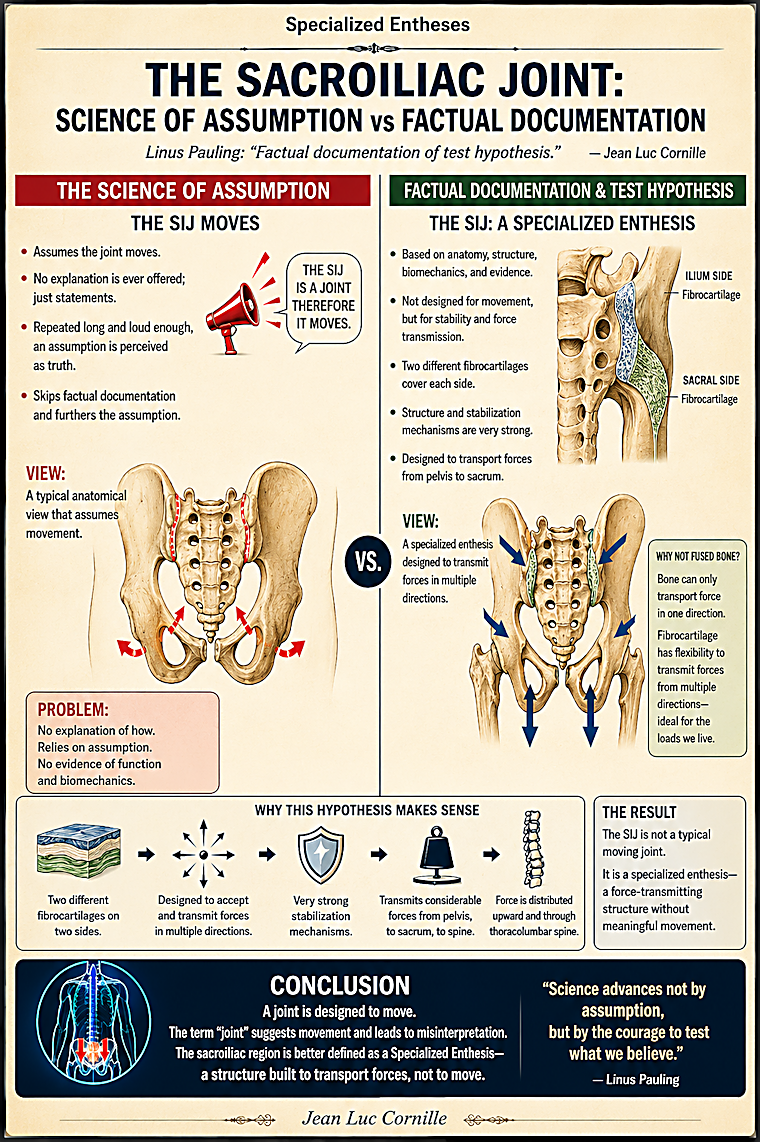
Linus Pauling described scientific research as the factual documentation of a tested hypothesis. Gathering factual evidence is often difficult, time-consuming, and expensive. There is, however, a far easier path—the science of assumption.
The science of assumption bypasses evidence and replaces investigation with repetition. Given enough time, ideas repeated often and confidently begin to acquire the appearance of truth, even when they remain unsupported by factual documentation.
The sacroiliac joint (SIJ) is a perfect example.
Conventional thinking often describes the SIJ as a joint that moves. Yet this assertion is typically presented without explaining how such movement could occur despite the joint's remarkable anatomical stability. Statements are repeated, but evidence remains scarce.
When examined through the lens of anatomy and biomechanics, the sacroiliac joint suggests a very different interpretation.
Its robust ligamentous support and unique structural design indicate that, although traditionally classified as a joint, the SIJ functions more like a specialized enthesis—a structure optimized to transmit enormous forces from the pelvis and hind limbs into the sacrum and onward through the thoracolumbar spine.
This perspective also answers a question that has puzzled many observers:
If the sacroiliac joint does not move, why has evolution not fused it into a single bone?
The answer may lie not in movement, but in force transmission.
Unlike bone, fibrocartilage possesses a degree of elasticity. That flexibility allows it to accommodate and transmit forces arriving from multiple directions. Bone is exceptionally strong under compression, but its rigidity makes it less adaptable to the constantly changing vectors of force generated during locomotion.
The sacroiliac joint is uniquely constructed for this task.
Its sacral and iliac surfaces are covered by two different types of fibrocartilage, each possessing distinct mechanical properties. This specialized arrangement suggests a structure designed not to permit meaningful motion, but to efficiently receive, distribute, and transmit multidirectional forces between the pelvis and the spine.
This hypothesis provides a logical explanation for the joint's distinctive anatomy.
If future research continues to support this interpretation, it may also encourage a reconsideration of the terminology itself. The word joint naturally implies movement, while the primary function of the sacroiliac complex may instead be the controlled transmission of force.
Viewed from this perspective, the sacroiliac joint becomes something more accurately described as a specialized enthesis—a remarkable biological structure whose purpose is not mobility, but the efficient transfer of forces essential for athletic performance and sound locomotion.
Jean Luc Cornille
