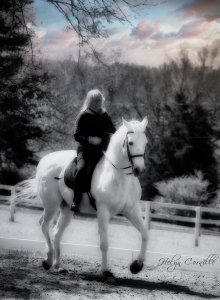
Leonardo da Vincy (1452-1519) was a gifted rider.
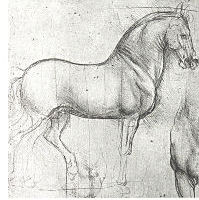
His legacy goes beyond the Sforza equestrian model.

In two sentences, the Renaissance’s Master launches modern riders and trainers on the path of success:
“All our knowledge has its origin in our perceptions.”
(Leonardo da Vinci)
“Be sure you know the structure of all you wish to depict.”
(Leonardo da Vinci)
There is a lot to learn from, re-educating a horse
A recent ad about how difficult it is to quit smoking states that the failure is not on the part of the individual but rather, the system has failed the individual. Since I do not smoke I cannot judge the veracity of the advertising. However, the concept is definitively accurate when it comes to a horse’s injury. In most instances, it is not the rider who failed the horse but rather it is the system which failed both horse and rider.
There is a lot to learn from the re-education of damaged horses simply because the re-education is exactly that which, if done initially, would have allowed the horse to perform to his full potential and remain sound. In many instances, soundness could be restored, and horses could return to a successful life. Very few though, are given a chance because it is difficult for the rider to face the thought that one may have caused the problem. The guilt is misplaced. In most instances, it is not one’s skill or lack of skill that lead the horse to lameness but rather the system that emphasizes riding and training principles unrelated to the horse’s physiology.
James Crook wrote, “A man who wants to lead the orchestra must turn his back on the crowd”. Once again, the metaphor applies to the horse. The system wants you to believe that equine athletic performances can be enhanced by increasing the amplitude of the horse vertebral column’s movements. In reality, while in motion, the range of movement of the equine spine is very limited and the primary function of the back muscles is precisely to protect the vertebral column’s structure from any amplitude of movements which would exceed the vertebral column’s possible range of motion. Efficiency is not about greater amplitude of vertebral column movements but rather better orchestration of numerous but minuscule muscle contractions and compensatory contractions.
When a horse is crippled as a result of having been trained deep and low, and heavily on the forehand, soundness cannot be restored by working the horse lower and more forward. The problem is that by questioning the theory, one stands against the crowd. The thought might be scary at first, but after all, if one truly likes music, it is more pleasant to face and direct skilled artists that are creating the music than to face a crowd that is quick to criticize but does not have any idea on how to play the violin.
The horse is a skilled artist, which by nature and also by intelligence enjoys using his physique. Comfort is a main concern of the horse’s self preservation instinct and performing at ease is naturally more attractive for the horse than under painful constraints. If one truly loves the horse, the pleasure of a performance achieved in great harmony and ease and accuracy and soundness, is unmatchable even if the blue ribbon goes to someone going faster, riding a horse addicted to anti-inflammatories and hyaluronic acid.
Molly Ivins says, “The first rule of holes: When you’re in one, stop digging”. Walter Zettl wrote, “Ride your horse into heaven and not into the ground”. When your horse is in the hole, stop digging his grave. Heaven is higher and I do not refer solely to the neck posture but also to the rider’s standards. Look at what needs to be done to allow a horse once driven into a hole to breathe again and you will understand how to educate your horse in the first place.
Judging standards, riding principles, training techniques, books, practical application of scientific findings, and panel discussions all follow the thought that the horse’s lower line, which includes abdominal, pectoral, and neck muscles, flexes the horse’s upper line, the vertebral column and surrounding muscles. We have explored instead the thought suggested by Richard Tucker and James Rooney, as well as that in the works of Leo Jeffcott, Jean Marie Denoix, Kevin Haussler and many others. Also considered were the researches based on dynamics models that were executed by Anton J. van den Bogert and many others. The working hypothesis was that while the muscles of the horse’s lower line are definitively involved in locomotion and athletic achievements, their influence on the horse’s vertebral column are elementary, and therefore ill adapted to the sophistication required by modern performances. Instead, the muscular system situated directly above the vertebral bodies has the capacity to orchestrate the vertebral column mechanism at a higher level of sophistication.
This muscular system is extremely complex and cannot be efficiently influenced by acting, at one end on the engagement of the hind legs, and at the other end on the neck posture. It was then necessary to figure how the rider could access and influence the horse’s vertebral column’s biomechanical properties. The Science of Motion response comes by combining an actual understanding of the vertebral column mechanism and the teaching of great masters. The biokinematics of the equine vertebral column, and consequently the kinematics of the limbs, (quality of the gaits) and the horse’s ability to perform at its utmost potential, while remaining sound, can be influenced by the biomechanical properties of the rider’s vertebral column.
This is a fundamentally new approach and of course like everything new, we are encountering panic and heavy resistance. Panic results from the fact that the most aggressive opponents know deep in their mind of the short cuts of their beliefs and their application and are afraid to face the thought that they might have to evolve. The response to skepticism is the horse’s soundness. Correct orchestration of the horse vertebral column properties not only allows the horse to perform better and remain sound, but re-educations once not even considered are now truly possible. Lameness issues that cannot be solved through traditional and alternative therapies can be resolved by acting on the source of all body movements, the horse’s vertebral column.
We document these impossible re-educations and publish the documentation in DVD format once the re-education has been successfully completed. The DVDs contain pertinent but proven information. The horse was lame and the horse is now sound. The horse was a mediocre mover and turns into a world class athlete. The horse cannot piaff and he does. The horse cannot jump the water and he jumps the water. There is no cure for kissing spine and the ‘kissing spine’ horse returns to normal life and performances.
Preface
From the wisdom of Centuries to modern day’s theories, flexing the horse’s upper line, or vertebral column, is achieved by shortening the horse’s lower line, involving abdominal muscles, pectoral muscles, and flexion of the neck.
In 1946, E. J. Slijper proposed the “bow and string” metaphor in which the horse’s vertebral column is the bow that can be flexed, thereby increasing the tension of the string, which is composed of abdominal and pectoral muscles, and those of the limbs. Later Dr Deb. Bennet focused on muscles named “scalenus” that are situated at the junction between the thoracic and cervical vertebrae. The scalenus muscles connect the string to the bow and the “bow and string” concept become the “ring of muscles.”
Every principle of riding which emphasis flexion of the back through engagement of the hind legs at one end, and flexion of the neck at the other, are based on the “bow and string” or “ring of muscles” concepts.
In 1964, Richard Tucker initiated new studies of the equine vertebral column from the perspective of the forces which act upon the vertebral linkage. The polish scientist introduced the thought that the muscles attached on the vertebral bodies and their dorsal spinous processes were the superior mechanism of balance control. These muscles are directly involved in the capacity of the horse’s vertebral column to convert the thrust generated by the hind legs into forward motion (horizontal forces), and resistance to gravity and by consequent balance control (vertical forces). The pertinent evolution is that instead of resulting from overall flexion and extension of the spine, the management of the thrust generated by the hind legs is effectuated at the level of each vertebra. “An initial thrust on the column is translated into a series of predominantly vertical and horizontal forces which diminish progressively as they pass from one vertebra to the next” (Richard Tucker, 1964) .
CLICK HERE TO READ ON
One Hand on His Shoulder
(It is now a classic)
.
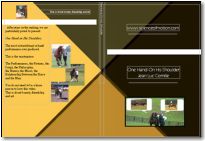
The most extraordinary in hand performance ever produced.
This is the masterpiece
The Performances, the Pictures, the Script, the Philosophy,
the Humor, the Music, the Relationship Between the Horse and the Man.
You don't need to be a horse person to love this production.
This is about beauty, friendship and art.
"I started the work in hand as a scientific experiment. The purpose was to see if a horse trained to always coordinate his body for the performance was capable to coordinate his physique by himself when a rider was asking for the movement. Knowing that as long as I will be on the saddle I will unconsciously help the horse, the thought was that such help would be impossible in hand. The horse, and all other horses after him, redirected the experiment toward a very different direction. The horse taught me as he will to everyone watching this video, a totally new equestrian philosophy."
Jean Luc Cornille
Love the harmony and cherished relationship your videos bring to viewers. One hand on shoulder, wow! The gesture is so simple and yet so full of trust and love and shared being in the moment. Thank you! George Buggs
“One Hand On His Shoulder” is an amazing bit of fresh air. Breaking with tradition Jean Luc Cornille demonstrates, with great intellect and humor, just how much the horse can teach the humans with which they interact. With grace and artistry Mr. Cornille presents his work in-hand with Lafayette clearly showing that so much more can be accomplished if we accept and listen to the horse. A lovely video that brings back the art of horsemanship and has certainly inspired me to listen more and demand less of each horse I work with. Susan Hopf
|
DVD/Video
Buy
In the Series
Educating your Eye,
We are proud to present
"The Horse Who Could Not Trot”
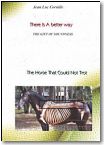
DVD/Video
English and French Version
Beyond Expectations
“It is hoped that consideration of the normal system will illumine the abnormal as well as the abnormal illumining the normal.”
(James R. Rooney, Biomechanics of lameness in horses, 1969)
At first the Science of Motion concentrated on better performances. Then, friends, who were also desperate horse owners, pleaded to explore the thought that addressing the source of the problem, the horse’s vertebral column, could also help solving unsolvable lameness.
Studying the abnormal illuminated the normal; the very same technique that recreated soundness, unveiled gaits and performances previously out of reach.
Beyond Expectations: Navicular syndrome and beyond.
(Case Study)
.
Dominique (1969 - 2005) Click Image
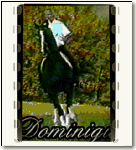
At age 17, Dominique was diagnosed with navicular syndrome. Previous to the disease, Dominique had great difficulties to perform tempi changes. He was executing a short series of three or four changes and then needed several canter strides before he was able to execute another short series.
Soon, heavy lameness rendered the problem irrelevant.
Interestingly, the technique applied to restore soundness allowed the horse, once soundness was recreated, to perform with great ease, long series of tempi changes.
Beyond Expectations: The horse who would not jump the water
(case Study)
The horse had the scope to fly over a Grand Prix jumping course but had also developed an “attitude” toward water jumps. In fact the behavior was categorical. The horse refused purely and simply to jump the water.
Now, the horse does fly effortlessly over the water. The behavior was in fact due to muscle pain. Strong back muscle imbalance was inducing pain upon landing of long and low jumps such as the river. Addressing the back muscle imbalance, and consequently suppressing the feeling of pain associated with the landing of the water jump was enough to change the horse’s mind about jumping the water.
The video was the first attempt over the water after reeducation
Click On Photo For Video
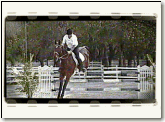
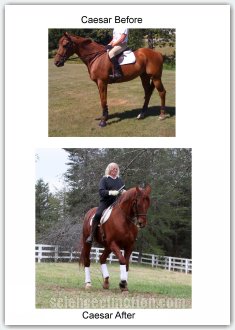
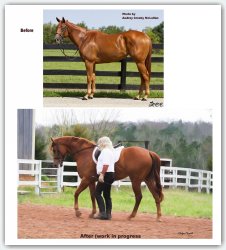
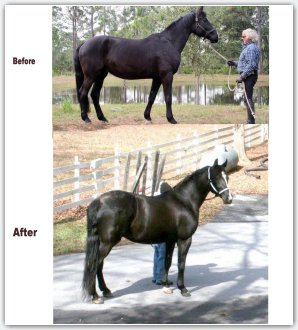
Some horses can recover from irreversible problems because the issues were irreversible until someone found the solution. Other horses may unveil outstanding performances because the outstanding performances were within their potential all along but their talent was altered by training techniques ill-adapted to their physique, or temperament, or both.
Beyond Expectations: A case of kissing spine.
(Case Study)
Biomechanics of the horse
While recently, new surgical techniques are offering a solution to the problem of “Kissing Spine,” The aftermaths of invasive surgery are raising serious questions by comparison to a non-invasive approach that only take a few months.
This horse was diagnosed with kissing spine between L4 and L5. As a result of the pain related to the situation, the horse had developed serious behavior problems. The kissing spine situation was approached addressing the back muscle imbalance that placed the spine into damaging alignment. The reeducation was fully done in motion. It was physical therapy.
Click On Photo for Video
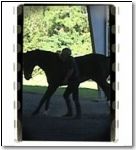
It took three months for the horse to realize that he was working pain free. His bad behavior vanished as the comfortable working attitude became consistent. Within six months the horse was kindly, happily, and beautifully working. He was ready to go home.
The Abnormal Illuminating The Normal
During his reeducation, the horse was absolutely unable to deal with a firm contact on the bit. He was also reacting strongly and angrily to any shift of the rider’s weight. Basically, the horse was unable to deal with the most common concept of modern equitation, “driving the horse onto the bit.” The fact that a horse with a particularly sensitive vertebral column structure cannot deal with the concept of “driving the horse onto the bit” raises pertinent questions about the riding technique. Could it be that the concept alters as well the vertebral column mechanism of normal horses even if they have enough strength and stoicism to live with it?
The observation was not unique to this horse. Whatever the horse’s issue, kissing spine, stifle problem, navicular syndrome, the two perquisites for all reeducations achieved at the center have always been and are always reducing the pressure that the horse is exerting on the bit and placing the rider in authentic balance.
Heavy contact on the bit and shifts of the rider’s weight are drastically altering all horses’ ability to function soundly.
Both, advanced scientific studies and classical authors fault the driving aids. “The methods used in equestrian art are numerous and varied. Some people have been able to sum them up succinctly and picturesquely in the formula: “Push and Pull,” but no great profit, obviously, can be derived from this sally.” (General Decarpentry, Academic Equitation, 1949)
The horse’ vertebral column functions within the limits of a very limited range of motion.
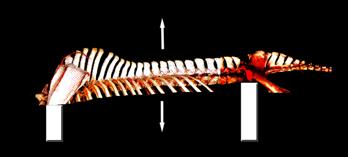
“Thus the total range of movement in the dorso-ventral directions of the equine back was only 53,1 mm under these experimental conditions.” (Leo B. Jeffcott, Natural Rigidity of the horse’s backbone, 1980. Equine vet J. 1980, 12 (3), 101-108)
Gaits and performances cannot be enhanced increasing the horse’s vertebral column’s range of movement. “The primary function of the back muscles during walking is to control the stiffening of the back rather than to create movement.” (Hans Carlson, (1979) Back muscles are preeminently designed to protect the vertebral column from movements exceeding its possible range of motion.
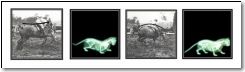
Hans Carlson experiment was initially effectuated on cats. The fact helps to understand the true meaning of the word “stiffening.” The Swedish author does not think about stiff protective reflex contraction, as the equestrian language would interpret the word, but rather increase in muscle tone.
Both, the horse and the cat absorb the impact of a heavy landing resisting excessive arching of the vertebral column stimulated by gravity. The muscular resistance induces at the next instant, a flexion of the thoracolumbar spine.
Beyond Expectations:
From mediocre gaits to world class movement.
(Case Study)
Equine Biomechanics
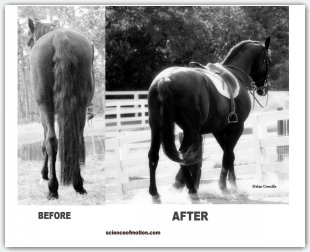
Outstanding gaits and performances, and soundness, can be achieved by enhancing the subtle orchestration of numerous and minuscule back muscles’ contractions that are creating the horse’s movement.
The practical application of this concept is demonstrated here
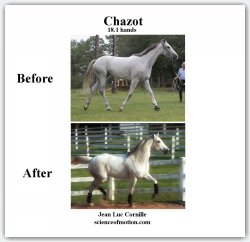
From mediocre gaits to world class movement (click photo for video)
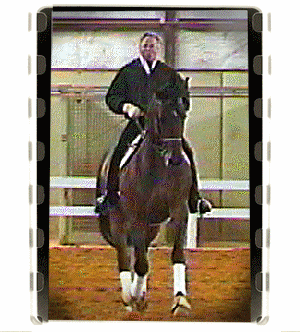
He is a 18.1 hand superb athlete moving like a Shetland pony. The paradox has been created driving the horse onto the bit. The abnormality has been corrected orchestrating properly the multiple and minute muscles contraction creating the work of the horse’s vertebral column.
Watching the transformation one might think with skepticism: “how the horse’s vertebral column can create such forelimbs movement?” The answer is in actual knowledge of the equine physiology.
CD Book
What is the Science of Motion®
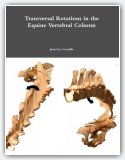
Transversal Rotations in the Equine Vertebral Column.
by Jean Luc Cornille
(In this study, the terms "Axial" and "Transversal" have the same meaning.)
Lateral bending of the equine vertebral column is always associated with a movement of transversal rotation. As well, axial rotation is always coupled with lateral bending. "In the cervical and thoracic vertebral column, rotation is always coupled with lateroflexion and vice versa." (Jean Marie Denoix, Spinal biomechanics and functional anatomy, 1999).
For the same lateral bending, two rotations are possible. One iscorrect, predisposing the horse to efficient use of his physique. The other one is inverted creating stresses and strains on the vertebral structures and consequently protective reflex contraction of the surrounding muscles.
Many riding and training principles, which have been conceived prior this knowledge, are unconsciously creating inverted rotation. These principles are ultimately hampering the horses' potential.
From the history of the scientific research to the practical application into riding and training principles, this abundantly illustrated study shows and explains how proper and inverted rotations look like, feel like, and can be corrected by appropriated riding techniques and gymnastic exercises
|
A gifted horse will lead a good rider to victory. A great rider will give to the horse the gift of soundness. Jean Luc Cornille Copyright©2010
Horse, rider training, in hand dressage, Courses, equine biomechanics, clinics, lectures,dressage, jumpers, lameness and behavior issues.
|