

Chrysalis-Foundation
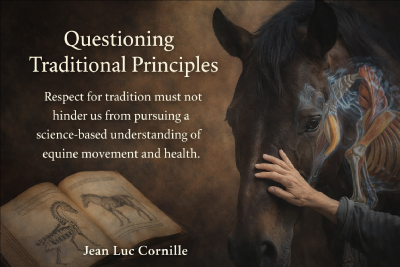
THE SCIENCE OF MOTION — CHRYSALIS 2027
What if the problem isn't what the horse is doing, but what the horse's body is unable to do?
For generations, horse training has relied on established exercises, methods, and formulas. Yet an exercise cannot produce its intended benefit if the horse lacks the body coordination necessary to perform it correctly.
What happens when we begin with an understanding of the horse's physiology rather than a prescribed training formula?
This is the foundation of The Science of Motion's 2027 Chrysalis Courses.
Chrysalis introduces a new generation of training: intelligent, efficient, scientifically informed, and gentle.
Our focus is on the athletic demands of performance and the coordination the horse needs to meet those demands. Rather than repeating movements that may reinforce dysfunction, we learn to identify the underlying mechanical difficulties and develop the horse's ability to move with greater efficiency and soundness.
The physical education is therapy.
Each week, members receive an educational document exploring equine biomechanics, physiology, and training principles. The learning continues through friendly discussions, questions, and videos submitted by members for individual analysis.
No question is too simple. No one is expected to abandon years of experience overnight.
New knowledge often challenges familiar beliefs. Chrysalis provides an environment where those questions are welcomed, examined, and answered through scientific understanding and practical observation.
For returning members, 2027 offers an opportunity to continue developing their knowledge and refining their work.
For those joining us for the first time, it is an invitation to discover a different way of understanding and educating the horse.
We do not simply teach the horse to perform an exercise. We teach the horse's body how to meet the demands of that exercise.
The Science of Motion
Jean-Luc Cornille
Chrysalis Courses 2027
Online Course Overview
Science of Motion – Chrysalis Foundation Master Course
$145 USD monthly for 12 months
Learn on your own schedule.
This course does not run on live sessions. All lessons are posted online in the private group. You can join anytime, read posts, watch or post videos, and ask Jean-Luc questions whenever it fits your schedule.
A Year-Long Journey Into the Real Mechanics of the Horse
Biotensegrity



The Science of Motion 2027 Master Course is a comprehensive, immersive program designed to elevate your understanding of the horse’s functional biomechanics, coordination, and balance. Rooted in classical knowledge but guided by modern science, this course unites past and present, theory and practice, sensation and evidence.
Rather than teaching formulas or surface-level repetition, the Master Course reveals how the horse truly moves, how forces interact within his body, and how the rider can communicate with precision, tact, and fairness. You will learn to interpret subtle cues, recognize early signs of dysfunction, and guide your horse toward healthier, more efficient coordination—whether your goal is performance, rehabilitation, or lifelong soundness.
Each lesson builds logically on the one before it, giving you the tools, sensitivity, and insight to understand your horse’s movement as never before. The course grows with you, meeting you at your level and steadily expanding your perception, skill, and physical intelligence.
What You Will Learn
1. The True Nature of Equine Balance
• Why balance cannot be understood through a linear lens
• How lateral, transversal, and multidirectional forces shape movement
• How classical interpretations evolved—and where they were limited
• How to feel balance through physical intelligence rather than habits or assumptions
2. Understanding Multidirectional Forces
• Interaction of forces during locomotion, transitions, collection, and turns
• Why the hind limb’s alighting phase does not propel the body upward
• How rotational forces influence stability and soundness
• Exercises that refine coordination without stress or force
3. Rider Influence and Communication
• How the rider’s posture, timing, and intention impact balance
• The communication of micro-adjustments horses can actually perceive
• Developing tact, sensitivity, and a quieter dialogue
• The role of mistakes—how to interpret and use them constructively
4. Functional Anatomy & Real Biomechanics
• Detailed exploration of the spine, joints, and muscular chains
• How forces travel through the body
• Understanding natural compensations and why horses default to them
• Recognizing early dysfunction and addressing it before it escalates
5. Reconditioning & Rehabilitation Principles
• Why horses instinctively protect dysfunction instead of correcting it
• How to guide a horse out of compensation safely
• The difference between gymnastic development and mechanical repetition
• Rehabilitating with precision rather than guesswork
6. The Rider’s Physical Intelligence
• How the nervous system senses and responds faster than thought
• Practical methods to refine your proprioception
• Bringing your awareness closer to the horse’s level of tactile sensitivity
• Techniques to train perception as you develop the horse
7. Classical Knowledge Re-Examined Through Science
• How historical authors interpreted sensations
• What they understood—and what they could not yet know
• Updating classical wisdom through modern biomechanics
• A new integrated perspective that honors the past and clarifies the future
8. Application to Performance & Daily Training
• Translating advanced science into practical riding
• Improving transitions, straightness, strength, and flexibility
• Developing high performance without sacrificing soundness
• Long-term strategies for maintaining a healthy, expressive athlete
Who This Course Is For
• Riders seeking lightness, precision, and effortlessness
• Trainers wanting deeper scientific understanding
• Riders rehabilitating horses with chronic or recurring issues
• Students who have felt traditional explanations were incomplete
• Anyone wanting a long-term partnership built on clarity and fairness
The Outcome
By the end of the Master Course, you will be able to:
• Understand the real mechanics of your horse’s movement
• Recognize dysfunction before it becomes a problem
• Guide your horse toward healthier coordination and greater ease
• Make sense of sensations that once felt confusing or contradictory
• Ride with more confidence, clarity, and compassion
• Bring science, tradition, and intuition into harmony
Chrysalis Foundation and Chrysalis Legacy
The Chrysalis Foundation course is the starting point for new students. This year-long online program introduces the essential concepts, lessons, and discussions that form the basis of the Chrysalis study. Students may join, learn at their own pace, follow the weekly material, post questions, and develop their understanding of the horse’s biomechanics, coordination, and soundness through the Science of Motion approach.
After completing Chrysalis Foundation, students who wish to continue their study may join Chrysalis Legacy.
Chrysalis Legacy is the continuing monthly program for students who have already completed the original Chrysalis course or the Chrysalis Foundation year. Legacy allows students to remain connected to Jean Luc Cornille’s ongoing work, new weekly material, continuing discussions, and deeper exploration of the Science of Motion principles.
In this way, Chrysalis Foundation gives new students a clear path into the work, while Chrysalis Legacy provides a place for continuing students to keep learning, refining, and evolving.
Need more information?
Contact: helyn@scienceofmotion.com
